
Enjoying Tokyo Street Karts Unencumbered: Dropping Off Your Bags First, and How the Scenery Changes Across Four Areas
Enjoying Tokyo Street Karts Unencumbered: Dropping Off Your Bags First, and How the Scenery Changes Across Four Areas
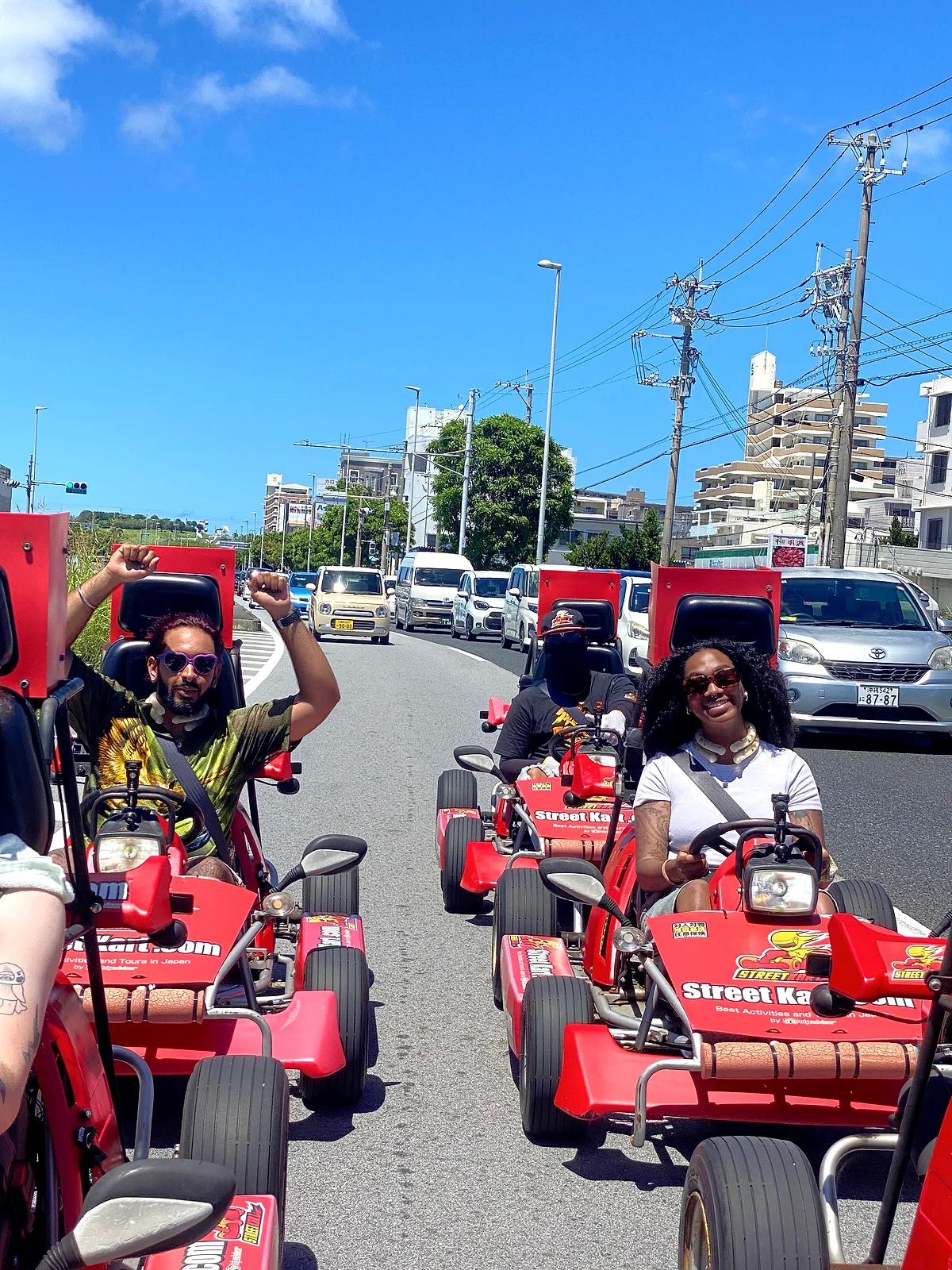
The light turns green. From your low seat, you watch Tokyo start to slide slowly past you. A red tower flashes into view beyond an elevated highway, and one turn later, you can smell the sea.
If you're busy worrying about the bag at your feet in a moment like that, you're missing out.
For riding a street kart in Tokyo, I think the most important part of preparation is how much you bring. The closer you get to empty-handed, the more fully you can take in the scenery that keeps changing in front of you. This article is organized around what scenery you'll see from each Tokyo location. It also covers where to leave your bags before you arrive, and how to plan the day when your group has a mix of ages and energy levels.
Without Bags at the Edge of Your Vision, the Scenery Looks Completely Different
Street karts are single-seaters. They have no roof, and the seat sits just above the ground. I'll cover the vehicle itself later on, so for now just remember one thing: don't come expecting to ride with large luggage on board.
How much can you carry during the tour? Can the location hold your bags? How big can stored items be? These details may vary by location and by day, so this article won't give definite answers. Check the Street Kart official website before you come, and ask ahead about anything that isn't clear. That alone will save you from scrambling on the day.
So flip the question around. Instead of asking "What should I store?", start with "What's the minimum I'll bring?"
Leave suitcases and shopping bags somewhere before you ride, like your hotel or a station locker. Keep only the documents you'll need at check-in, your phone, and a few small items. For documents, your original driver's license is essential. What else you'll need depends on the type of license you hold, so check the official website.
When that's all you're carrying, you'll feel the difference the moment you set off.
Think of a day at the beach when you went with nothing but sandals and a towel. Didn't the waves feel closer? The less you carry, the closer the sea and the city feel. I think karts work the same way.
It's also important to put away anything the wind could carry off: a wide-brimmed hat, a stole draped loosely around your neck, a phone half sticking out of your pocket. In a vehicle with no roof, the wind hits more than just your face.
And don't hold your phone while driving. The scenery is better taken in with your own eyes, following the guide and watching the road ahead, than through a screen. Before and after the ride is plenty of time for photos.
Each Tokyo Location Offers Completely Different Scenery
Street Kart has nine locations nationwide: seven in Tokyo, plus one each in Osaka and Okinawa.
The seven Tokyo locations aren't spread across seven separate areas, though. Akihabara Store 1 and Store 2 are practically in the same place, and so are the Shibuya store and Shibuya Annex. So if you're choosing by scenery, it's simplest to think in terms of four areas: the Bay Area, Shinagawa, Akihabara, and Shibuya.
On every tour, a guide leads you along a course set by that location. In other words, the location you pick decides what you'll see that day. Below are the landmarks visible along each location's course. For finer details, like which tour passes which sights or what happens partway through the ride, check the official website.
Tokyo Bay and Shinagawa: From Warehouse Districts to the Sea, and On to the Tower
The Tokyo Bay store in Shinkiba starts you off under a wide-open sky.
The Bay Area roads, lined with warehouses, are open, and a salty breeze hits you head-on. Before long, Odaiba's futuristic buildings come into view, and you draw closer to the Rainbow Bridge, 798 meters long, spanning Tokyo Bay. In the distance stands the 333-meter Tokyo Tower. Built in 1958, the red-and-white tower peeks out between the newer waterfront buildings.
In a word: "from wide-open spaces to the symbols of Tokyo."
At night, the Rainbow Bridge lights up in seven colors, so the same bridge can look like something else entirely depending on the time of day. Sunset times vary a lot by season, though, so I can't promise you'll see it at any particular hour.
The Shinagawa store in Kita-Shinagawa also has the Rainbow Bridge and Tokyo Tower in its course scenery. What makes this one interesting is the transition on either side of them. You go from the calm streets of Takanawa, home to historic temples and embassies, to the Shibaura and Tamachi waterfront lined with office buildings. Old Tokyo and glass-walled Tokyo swap places almost seamlessly.
On the luggage front: the nearest station to the Tokyo Bay store is Shinkiba, an 8-minute walk away. The Shinagawa store is a 3-minute walk from Kita-Shinagawa Station on the Keikyu Main Line, or a 10-minute walk from Shinagawa Station.
Shinkansen bullet trains stop at Shinagawa Station, so some groups will probably head straight over after arriving in Tokyo. If that's you, it's far easier to drop your suitcases at your hotel first, or find a place to store them at the station, than to drag them to the store.
The stores have no parking, so plan to come by train.
The Shinagawa Prince Hotel is a 15-minute walk from the Shinagawa store, and the Tokyo Bay Ariake Washington Hotel is about 10 minutes by car from the Tokyo Bay store. Stay around here and you can check in, drop off your bags, and head to the kart with nothing weighing you down.
The Two Akihabara Locations: From Illuminated Signs to Red Brick, and On to Ginza
Akihabara is, above all, full of color.
Giant electronics store signs, anime ads, the Yodobashi Camera and Akihabara UDX buildings. On Chuo-dori in the Electric Town, the upper half of your view stays a riot of color the whole way.
Then the scenery changes completely: the Marunouchi Building of Tokyo Station, which opened in 1914 and finished its restoration in 2012. After the neon, a solid red-brick building appears. Head on into Ginza and you reach the Ginza 4-chome intersection, with the Wako clock tower, and a grown-up streetscape lined with long-established department stores.
From the energy of subculture to a station building with 100 years of history, and then on to traditional, refined Ginza. It's like a blaring song suddenly switching to a quiet piano piece. I think that contrast is exactly what makes the Akihabara course fun.
The stores are a 5, 7 minute walk from JR Akihabara Station and a 3-minute walk from Suehirocho Station on the Tokyo Metro Ginza Line. Nearby hotels include APA Hotel Akihabara-Ekimae (3-minute walk), and remm Akihabara and Via Inn Akihabara (both 5-minute walks). Stay here and your luggage worries shrink considerably.
Akihabara is also a town where you'll want to stock up on souvenirs and electronics after the tour. My recommendation is "ride first, shop after." Rather than heading to your kart with an armful of shopping bags, get your ride in first, then stroll the Electric Town with both hands free. It's sure to feel better.
Shibuya and Shibuya Annex: From the Crowds at the Crossing to Zelkova-Lined Avenues
Shibuya starts with the crowds.
The Scramble Crossing, where it's said up to 3,000 people cross at once. SHIBUYA109. Hachiko Square. The moment the light changes, the whole city starts moving. No matter how many times you see it, that energy is astonishing.
Heading toward Harajuku, you enter the area around Takeshita Street with its colorful shops, and the youth-culture vibe gets stronger. Reach Omotesando, and the scenery suddenly calms down: the green of the zelkova trees, distinctive buildings designed by architects, Omotesando Hills.
From Shibuya's bustle to a polished, grown-up boulevard. You'll be surprised how much the city's volume can change within the same Tokyo.
The two Shibuya locations are in Maruyamacho, a 5-minute walk from Shinsen Station on the Keio Inokashira Line and a 10-minute walk from Shibuya Station. Shibuya Station has many transfers and sprawling concourses, and just dragging heavy luggage through it wears you out. Hotels nearby include Shibuya Excel Hotel Tokyu (10-minute walk) and Cerulean Tower Tokyu Hotel, so stay close and drop your bags first, and you can save your energy for the kart.
Making It Easy for a Group with Mixed Ages and Energy Levels
A trip with your parents. A trip where a group mixes 20-somethings with energy to burn and people who struggle with long walks. If you're touring Tokyo with a mix like that, things go smoothly if you decide from the start that "not everyone has to do the same thing at the same pace."
First, keep in mind that street karts have participation requirements. This article won't give definite answers on license, age, or other conditions. Please check the official website for details. If you build your itinerary assuming everyone will ride without checking the requirements, your plans may fall apart on the day. Decide who will ride first, then figure out how to use the rest of the time. That's the order I recommend.
Karts are single-seaters, so two people can't ride together. If some members won't ride, plan for them to spend that time somewhere else. This is where the differences in scenery between locations come in handy again.
In Akihabara, Kanda Myojin is a 10-minute walk away. Revered as the guardian shrine of old Edo, it offers a quiet that feels a world away from the bustle of the Electric Town. Ueno Park, 5 minutes by train, is home to Ueno Zoo and the Tokyo National Museum.
In Shibuya, Meiji Jingu and Yoyogi Park are both a 20-minute walk away, where you can relax amid broad forest and greenery. Some people may find a 20-minute walk tough, though, so share walking distances with everyone in advance.
In Shinagawa, it helps that Shinagawa Shrine is only a 5-minute walk away. However, its torii gate sits at the top of a stone staircase, so it may not suit anyone who has trouble with stairs. Tennozu Isle, a 20-minute walk away, has canal-side cafes and art galleries.
From the Tokyo Bay store, Odaiba is 10 minutes by car. It's an area packed with large shopping complexes.
For pacing everyone's energy, luggage really matters. If the riders travel light but the non-riders end up waiting with everyone's bags, it defeats the purpose. Drop off your bags at your hotel or the station before riding. Think of it as a rule for the whole group.
By the way, every location has restrooms inside and in-store Wi-Fi. There's also a convenience store within a 5-minute walk of each location.
Also, decide on a meeting place and time before riding. You can't look at your phone while driving, so just saying "I'll message you when I'm done" leaves the people waiting in a tough spot.
Once the ride is over, get everyone together and head off for a meal while talking about the scenery you just saw. Because each of you saw a different Tokyo, I think the conversation will flow.
What Makes Street Kart Appealing
Let me sum up the vehicle and the tour itself here.
First, the low eye level. Because the seat is close to the ground, the road you usually look down on is right in front of you, and the buildings tower overhead. You see the city from a different angle than when walking.
Second, there's no roof. The wind, the sounds of the city, the chatter of people you hear while waiting at a light. You take in the changing scenery not just with your eyes but with your skin and ears too. The salty air along the waterfront, the rustle of zelkova leaves on Omotesando. It's a vehicle that lets you feel all the changes in scenery I've described with your whole body.
Third, a guide leads the way. On every tour, a trained guide drives in front. Since you don't have to keep staring at a map, it's easier to focus on the scenery and on driving. At least, that's how I feel.
Fourth, each location has its own set course. Not being able to drive freely might seem inconvenient. But think about the openness of the Bay Area, the contrast from Akihabara to Ginza, the shift in volume from Shibuya to Omotesando. Choosing a location is the same as choosing the scenery you want to see. Looked at that way, it's a pretty fun system.
Fifth, the time spent riding together. Chasing the guide's back ahead of you, catching a friend's eye at a red light and laughing for no particular reason. I think those small moments are part of the tour too.
Sixth, the website supports 22 languages.
The track record numbers are useful too. As of November 2023, across all locations, they had run over 150,000 tours in total, served over 1.34 million customers, and received over 20,000 reviews with an average rating of 4.9 out of 5.0. All of these figures are as of November 2023, so keep in mind they aren't current.
Things to Check Before Booking
On tour day, instructions are basically given in English. Whether you can get guidance in Japanese or other languages depends on the staff that day and isn't guaranteed. If someone in your group isn't confident in English, it's reassuring to ask about any concerns through the official website before booking.
Reservations are accepted via Facebook, LINE, and email. Contact details are listed on the official website, so check there. Weekends tend to fill up fast, so if you want to ride on a weekend, it's best to book early.
Once your reservation time is set, work backward from it to decide where to leave your bags and which train route to take to the store. Thinking in that order makes the day's movements much simpler.
Participation requirements, dress code, course differences by tour, and handling of belongings. Everything this article didn't give definite answers on can be checked on the Street Kart official website. Prices vary by season and time of day, so please check the official website for the latest rates as well.
Will it be the wide sky over the bay? The contrast from neon to red brick? Or the gradual shift from the crowds at the crossing to the zelkova-lined avenue?
Pick one scene you want to see, drop off your bags, and head to the store traveling light. Then all that's left is to wait for the light to turn green.
This article was originally written in Japanese and translated using AI. Some expressions may read unnaturally, and we appreciate your understanding. For the most accurate and up-to-date information, please refer to the official site at kart.st.
Street Kart is not affiliated with Nintendo or the Mario Kart series in any way. We do not provide costumes of Nintendo characters, and such costumes may not be worn during tours even if brought by participants.