
Street Karting in Tokyo with Companions Who Don't Share Your Language: How Communication Changes by Day, Dusk, and Night
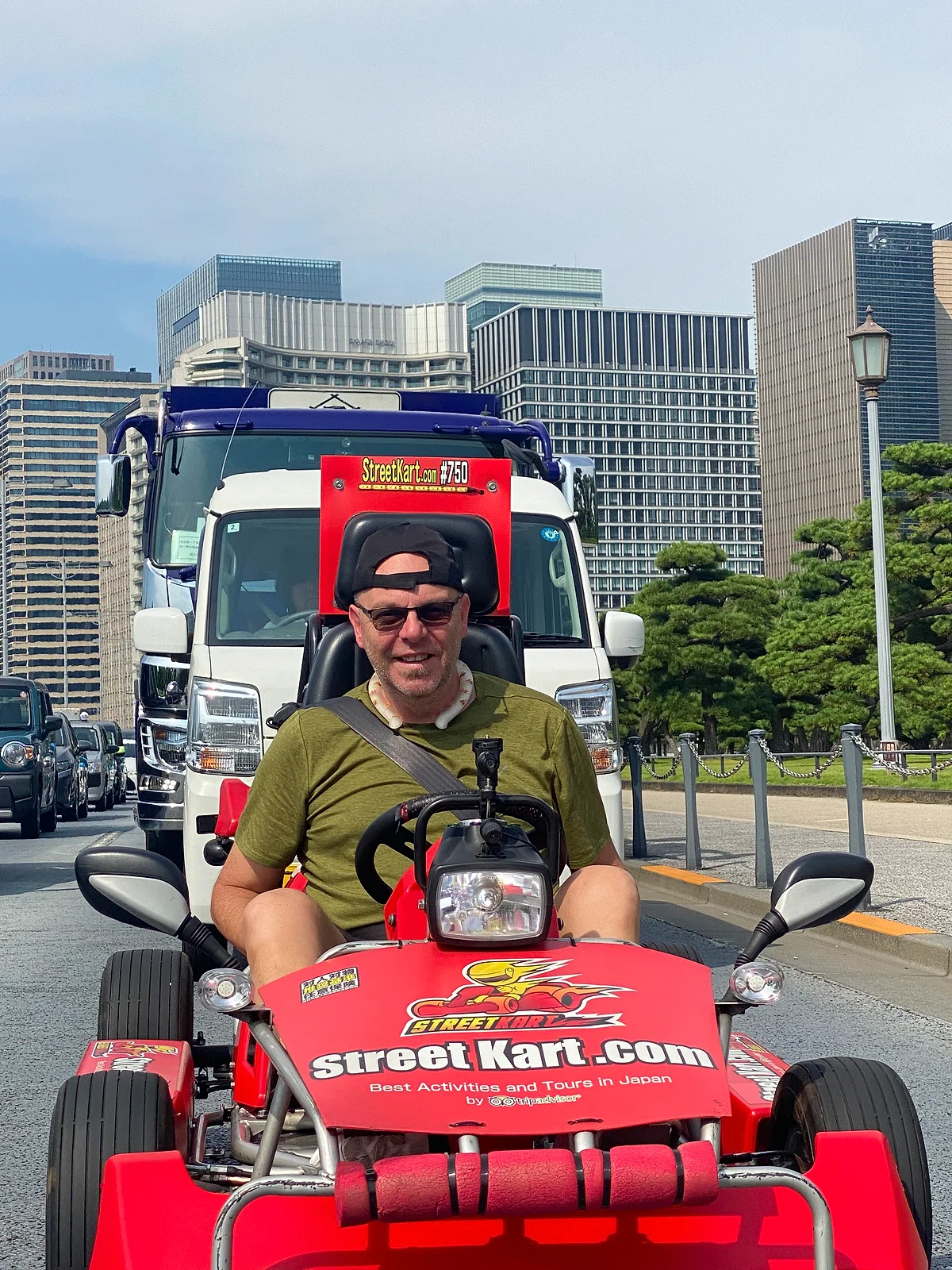
Street Karting in Tokyo with Companions Who Don't Share Your Language: How Communication Changes by Day, Dusk, and Night
You're the only one in your group who speaks English. Your mother, sitting next to you, speaks only Portuguese. Your brother-in-law understands a little English, but his stamina isn't great.
A group like this, with mixed ages and languages, runs into one problem in Tokyo: it's hard to find a place where everyone laughs at the same moment.
Street karting is a good fit for that kind of group. Nobody has long conversations while driving. Everyone is watching the guide up front and the traffic around them. It's a time for your eyes more than your words. Before you book, ask the official contact how instructions are given during the drive.
How you use your eyes changes with the time of day, though. Signals are easier or harder to see by day, at dusk, and at night. You get tired in different ways. The scenery looks different.
This article goes through what to prepare for each time slot when you're joining with someone who doesn't share your language. Sunset times and heat change a lot with the season, so instead of thinking in terms of "what time," we'll think in terms of "how bright it is" and "how much energy everyone has left."
Three things the whole group should agree on first
Before getting into time slots, settle the things that stay the same at any hour. If these are left vague, you'll end up scrambling between check-in and departure, which is when the language barrier feels highest.
The first is the language of instruction. On the day of a Street Kart tour, guidance is basically in English. Whether you get guidance in Japanese or other languages depends on that day's staff. It isn't guaranteed.
If someone in your group struggles with English, don't assume someone on site will interpret for you. Plan on the English speaker in your group being the interpreter. That way you'll be covered. If you have questions about language, contact them before booking and talk it over.
The second is who will drive. Who can drive depends on things like the type of license you hold, and this article can't give a definitive answer. Everyone planning to drive should check the latest license and participation requirements on the Street Kart official website before setting out.
The official website is available in 22 languages. If your companion's native language is one of them, you could have them open it themselves before the trip. It's a small bit of prep so the English explanation on the day isn't the first time they hear any of it.
The third is how the tour works. The karts are single-seaters. A guide drives at the front, and you follow a course set by each location. Check the official website for details like stops and how groups are put together.
One more important point: no passengers are allowed. Anyone who isn't driving will spend the tour around the shop. That waiting time also matters when you choose a time slot.
Daytime: signals and facial expressions are easiest to read
The biggest strength of daytime is visibility. The guide up front, the position of the kart ahead, what's happening at intersections: you can see all of it clearly. For someone who can't rely on words, the more information that comes in through the eyes, the better.
I think the pre-departure back-and-forth is also calmer during the day. If something in the English explanation isn't clear between check-in and departure, the interpreter can ask the staff again on the spot and pass it on to the companion.
Don't start driving without understanding. For groups with a language barrier, this matters more than anything else. In daylight, the scenery is less distracting, so it's easier to focus on that check.
Speaking of scenery, daytime is when you can enjoy the fine details. In the area listed in the materials as the Akihabara location's course, there are the colors of the Electric Town signs, the red brick of Tokyo Station's Marunouchi Building, and the Wako clock tower in Ginza.
At the Shibuya location, there's the green of the zelkova trees along Omotesando and the colorful storefronts of Harajuku's Takeshita Street. In bright light, you can even make out differences in building materials and colors. If someone in your group works in design, they might spend the whole day talking about the lettering on the signs.
On the other hand, daytime is when you need to watch your energy. Tokyo summers bring long runs of hot days, and depending on the season, the sun can be quite strong. How people handle heat tends to vary with age. If anyone is sensitive to heat, decide based on the season and that day's weather.
Drink water before the tour. Don't make the people waiting stand outside in strong sun. It helps to plan for the non-driving companions as part of the whole group.
Also, the midday right after a long flight tends to overlap with jet lag. Listening to an English explanation in a language you don't understand is tiring on its own. Skip your arrival day and schedule it around the middle of the trip, when everyone still has focus to spare.
Dusk: expect the light to change and prepare earlier
From late afternoon into sunset, Tokyo's scenery changes fast. The sky shifts color little by little, and lights start blinking on in office windows one by one.
The Rainbow Bridge, listed in the materials as part of the Tokyo Bay (Shin-Kiba) location's course, and Tokyo Tower, visible in the distance from the Shinagawa location, both look very different at this hour.
But sunset times shift a lot by season. The same "evening" can be still bright in one season and already pitch dark in another. So there's no saying "you'll see the sunset at this time."
If you're aiming for dusk, look up the sunset time for your travel dates yourself and compare it with the tour times you can book. Check the official website to see which time slots are available.
On the language side, watch out for the change in light. It can be noticeably brighter when you set off than when you return. Make sure the explanation you heard while it was light can still be recalled after dark. Be even more careful with your pre-departure check than you would be during the day.
For example, the interpreter can turn the safety points heard in English into a short note translated into the companion's language. If you're using a translation app, finish that inside the shop before departure.
Taking out a smartphone while driving is dangerous, so once you're in the kart, no looking at screens. Make that a promise the whole group keeps.
As for energy, late afternoon is when the day's fatigue sets in. After a morning packed with sightseeing, it can be a lot for older companions. On days you join at dusk, keep the morning schedule relaxed.
Night: the scenery takes center stage, so understanding beforehand matters most
Seeing Tokyo at night from the low seat of a kart, the wind and the sounds of the city hit you directly. The usual city starts to look like a different one.
On the Tokyo Bay location's course, the Rainbow Bridge is lit up in seven colors at night, a band of light floating above Tokyo Bay. There's also the neon of Akihabara's Electric Town and the lights of Shibuya's Scramble Crossing. Music lovers might see the whole city as one big stage.
The trade-off is that in the dark, faces and small hand movements aren't as clear as in daylight. So at night, understanding things before you drive is the foundation for everything.
What matters is whether your companion who doesn't share your language knows "what I'm supposed to do" before setting off. If you choose night, arrive at the shop with more time to spare than you would by day or at dusk. That gives you plenty of time between check-in and departure for checking.
I understand wanting to take photos. Everyone wants to remember the night view together. But take them before or after the tour, not while driving.
For example, at the Shibuya location you could stop by Shibuya Sky, the observation deck at Shibuya Scramble Square, before or after the tour and photograph Tokyo at night from above. One tip for night photos: steady your smartphone by resting it lightly against the glass or a railing. You'll get less blur, and the light trails come out cleanly.
As for energy, at night you'll want to think about what happens after it ends: the trip back to your hotel, plans for the next morning. If you have older companions, keep the morning after a night tour easy. That keeps the rhythm of the trip from falling apart.
Choose your location by working backward from the waiting time
If you're still deciding where to go, another approach is to choose a location based on the time slot along with how the non-drivers will spend their time.
Street Kart has 9 locations nationwide, 7 of them in Tokyo. Note, though, that Akihabara's 1st and 2nd shops are in nearly the same spot, and so are the Shibuya shop and Shibuya ANNEX. They aren't spread across seven different places in Tokyo, so keep that in mind.
Here we'll look at four areas with full materials available, Akihabara, Shibuya, Shinagawa, and Tokyo Bay, and how each one's options for waiting companions fit with each time slot. None of the locations have parking, so use trains and other public transportation to get there.
The Akihabara location is a 5, 7 minute walk from JR Akihabara Station. The surrounding area is Electric Town itself.
During the day, waiting companions can take a 5-minute train ride to Ueno Park and spend time at the Tokyo National Museum or Ueno Zoo. For those who'd rather have a quiet time, Kanda Myojin Shrine, a 10-minute walk away, is also an option. It's a good idea to agree on a meeting spot with your companions while looking at a map before departure.
The Shibuya location is a 10-minute walk from JR Shibuya Station and 5 minutes from Shinsen Station. For those waiting, Meiji Jingu and Yoyogi Park, about a 20-minute walk away, are good options: wide stretches of green right in the heart of the city. They could be a place for people who don't like crowds to catch their breath.
Walking conditions change once it gets dark, though. For a night tour, it's safer to have waiting companions spend their time in a building or café near the station.
The Shinagawa location is a 3-minute walk from Keikyu's Kita-Shinagawa Station. Shinagawa Shrine, a 5-minute walk away, is known for the torii gate at the top of its stone steps and its Fujizuka (miniature Mount Fuji). The steps can be hard on anyone with leg or back trouble, though, so don't push it.
Tennozu Isle, a 20-minute walk away, has cafés and galleries along the canal.
The materials list the Rainbow Bridge as seen from the Shinagawa side and Tokyo Tower in the distance as course scenery. It's an area worth choosing with the dusk-to-night views in mind.
The Tokyo Bay location is an 8-minute walk from Shin-Kiba Station. The materials list the Rainbow Bridge and Tokyo Tower as course scenery. If you want to see the nighttime illumination, this area is a good option.
For waiting companions, CASICA, a café-restaurant near Shin-Kiba, is a good option. Decide on the meeting spot and return time in advance.
Before booking: what to do for companions who struggle with the language
Some family get-togethers are loud, with everyone talking at once and having fun without anyone quite knowing who said what. In others, people take turns and wait for each other to finish. Both have their good points.
On a trip with someone who doesn't share your language, try borrowing a little of the "wait and confirm" rhythm. That alone makes things go much more smoothly.
Bookings are accepted via Facebook, LINE, and email (booking@streetkart.com). Weekends fill up quickly, so get in touch early once your dates are set. If you're worried about language, talking it over in English when you book can ease some of the anxiety on the day.
Prices vary by season and time slot. See the official website (kart.st) for details.
On the day, it helps to have two notes ready: one for writing down anything you didn't understand in the English explanation, and one with the safety points translated into your companion's language.
Also, agree with the non-drivers on a meeting spot and a rough return time while looking at a map. If they're waiting at a café, they can point at the menu and smile. That works more often than you'd expect. If you plan out the waiting time too, the day stays comfortable for everyone.
Will you enjoy the details in bright daylight, chase the changing sky at dusk, or drive through the lights at night?
The answer depends on your companions' stamina and how much language prep you can manage. Start by opening the official website, each in your own language, and looking together at which time works best.
On the day, you'll drive following traffic laws and the guide's instructions.
This article was originally written in Japanese and translated using AI. Some expressions may read unnaturally, and we appreciate your understanding. For the most accurate and up-to-date information, please refer to the official site at kart.st.
Street Kart is not affiliated with Nintendo or the Mario Kart series in any way. We do not provide costumes of Nintendo characters, and such costumes may not be worn during tours even if brought by participants.