
From the Bustle of Shinagawa Station to Quiet Kitashinagawa, One Street Back: Experiencing the City's Contrasts at Shinagawa Shrine and on a Street Kart
From the Bustle of Shinagawa Station to Quiet Kitashinagawa, One Street Back: Experiencing the City's Contrasts at Shinagawa Shrine and on a Street Kart
Step out of the ticket gates, and the first thing that hits you is the sound.
Suitcase wheels rumble. Station announcements wash over your head. Footsteps, chatter, departure bells. It all blends together into one big beat. That's the area in front of Shinagawa Station in Tokyo.
But walk a little way south, and the noise suddenly drops away. A shrine with stone steps. An old-fashioned shopping street. You find yourself wondering where all that commotion went.
That contrast is what makes Shinagawa so interesting.
In this article, we'll take you step by step from the bustle of Shinagawa Station to the quiet streets of Kitashinagawa, and then on to a street kart experience. We'll go one step at a time so first-timers won't get lost. Together, let's put together a route that lets everyone in your group enjoy the day at their own pace, whatever their ages and energy levels.
First, Soak Up the Energy in Front of Shinagawa Station
Shinagawa Station is a major terminal served by the Shinkansen, JR lines, and the Keikyu Line. It's sometimes called Tokyo's "southern gateway," and the area around the station is packed with tall buildings, including Shinagawa Intercity.
Commuters. Shinkansen passengers. Travelers.
The stream of people never stops. It's like a bassline that keeps on playing. Just standing here, you'll feel your body start to pick up the rhythm.
If it's your first visit, the crowds might make you a little tense. That's why the first thing to do is pick a place to rest. atré Shinagawa, connected directly to the station, or the Wing Takanawa station building let you take a breather without going outside.
If anyone is worn out from a long trip, this is the place to drink some water, use the restroom, and get everyone on the same page. Then move on. That's all you need.
Some of you may have just arrived by Shinkansen and be pulling a suitcase. The Street Kart shop has lockers for small items, but they aren't suited to large luggage like suitcases. The karts themselves can only hold a smallish bag. If you leave your big bags at your hotel and head to Kitashinagawa traveling light, the rest of the day will be much easier.
This is also a good time for everyone to check their clothes. If you're going to ride a kart, closed-toe shoes are recommended, and sneakers are best. Avoid sandals, heels, skirts, and dresses. It's also wise to leave expensive clothes at home for the day. Comfortable jeans or casual clothes work just as well for strolling the shopping street. Don't forget a jacket suited to the season. In summer, a hat, sunglasses, and sunscreen come in handy.
And one more important thing: the Street Kart shop has no parking. The company officially recommends using public transportation, so the safest plan is to come to Shinagawa Station by train and get around by train or on foot from there.
Think of the station-front bustle as something to enjoy watching. Don't push yourself to wander through the crowds. That alone makes a big difference in how tired you'll get.
Step by Step from the Station to Quiet Kitashinagawa
Once your ears have adjusted to the station noise, it's time to head one street back. The Shinagawa shop is in Kitashinagawa, where the atmosphere is completely different from the station area. Take your time and enjoy the change as it happens.
Walk or Take the Train? Decide as a Group
The shop is about a 10-minute walk from Shinagawa Station.
If you walk, you'll notice the cityscape gradually becoming lower and softer. That feeling of things slowly getting quieter is a bonus only walkers get.
If anyone is worried about their legs, Kitashinagawa Station on the Keikyu Main Line is convenient. It's a 3-minute walk to the shop. You can also get there in 7 minutes on foot from Shimbamba Station, also on the Keikyu Main Line.
The key point here is that not everyone has to get there the same way.
Those with energy can walk. Those who'd rather take it easy can ride the train. Then you all meet up in Kitashinagawa.
It's fine to keep things that loose. Group trips run smoothly when you leave this kind of slack.
The Volume Drops on the Kitashinagawa Shopping Street
When you arrive in Kitashinagawa, an old-fashioned shopping street awaits.
It shouldn't be far from the high-rises by the station, yet here the daily lives of locals unfold at a slow pace. The voices, the traffic, everything sounds completely different from the station area.
In music terms, it's like the floor-shaking EDM has ended and bossa nova has softly started playing.
The shopping street also has local restaurants, where you can eat in an atmosphere quite different from the big places by the station.
The Stone Steps and Fuji Mound of Shinagawa Shrine
About a 5-minute walk from the shop is Shinagawa Shrine, one of Tokyo's Ten Shrines.
Highlights include the torii gate at the top of the stone steps and the Twin Dragon Torii. The grounds also have a Fujizuka, a miniature Mount Fuji mound that you can climb.
The shrine is said to bring prosperity in business and good fortune with money, so stopping to pray before your kart ride is a nice way to order your day. You can reset the restless feeling from the station here before heading off to drive.
There are stone steps, though, which may be a bit tough for anyone with knee or leg issues. In that case, those who can climb can go up, and everyone else can wait at the bottom. Not everyone has to do the same thing.
If you want to go a little farther, Honsenji Temple is a 10-minute walk away. It's one of the Six Jizo of Edo and has a great temple bell designated a Tangible Cultural Property of Tokyo. The temple has a history of more than 1,200 years.
Connecting the Bustle and the Quiet in a Single Line with Street Kart
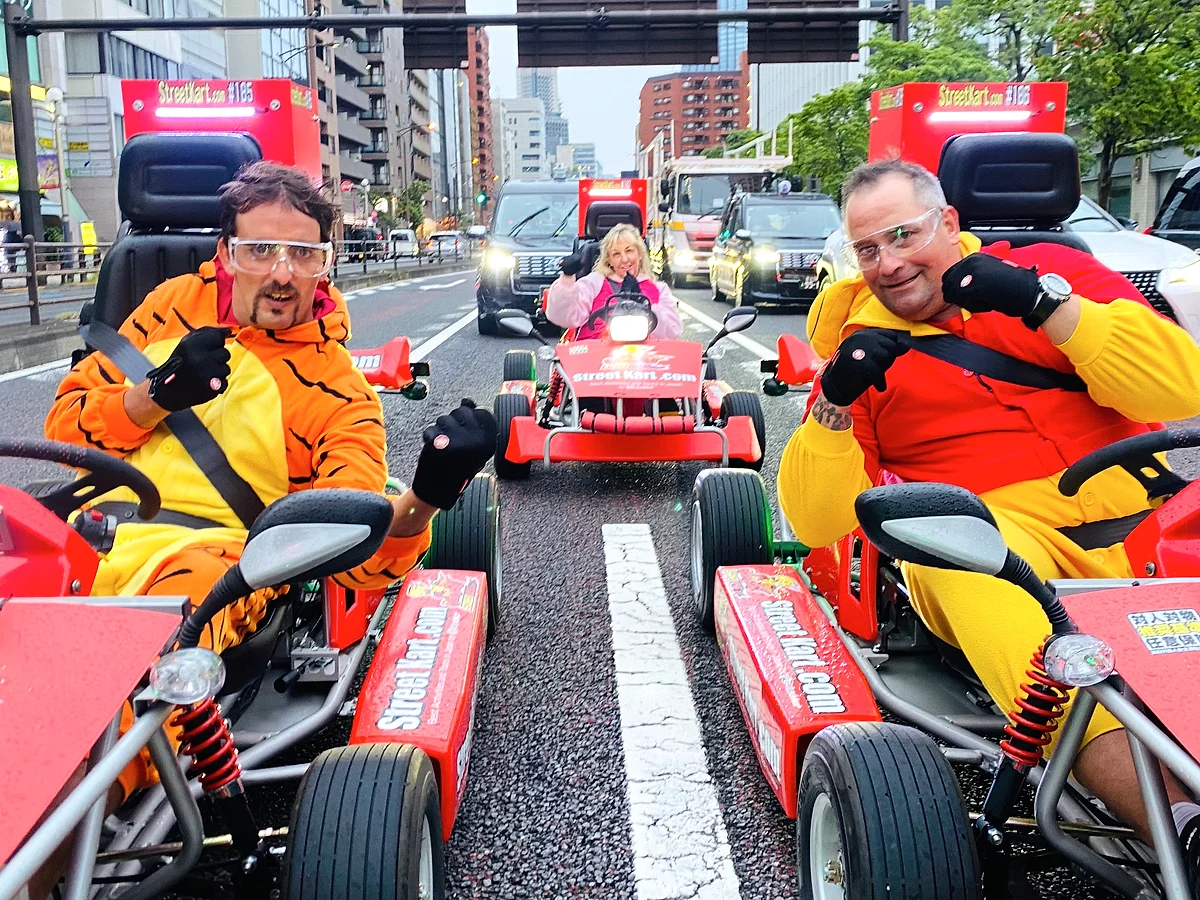
Once you've settled your mind in quiet Kitashinagawa, it's finally time for Street Kart.
Tours are led by a guide, and each shop follows a set route. Places like shrines and shopping streets that are best enjoyed on foot are better saved for before or after the tour.
The first highlight on the Shinagawa route is the business district around Shinagawa Station. You'll see the bustle you just walked through all over again, this time from a kart.
Then there's the Takanawa area, with its historic temples and embassies, and the Shibaura and Tamachi areas, where office buildings and waterfront views spread out. From the Shinagawa side you can see the Rainbow Bridge, and Tokyo Tower in the distance.
Before you set off, you'll check in at the shop and get a safety briefing covering how to operate the kart, the route, and what to watch out for. First-timers should listen carefully here. On the day, don't rush in at the last minute. Arriving with time to spare will help you feel more relaxed, too.
While driving, follow Japanese traffic rules and your guide's instructions. Obey traffic lights and signs. Keep a gap between you and the kart in front. Don't speed. The rules themselves are the same as when you drive a car.
The Shinagawa course also offers an evening time slot option when traffic is lighter. If you'd like to drive through a calmer city than the daytime station area, check the official website.
Grip the wheel, and the Tokyo wind hits your face. City sounds bounce off the buildings. Scenery streams past right beside you. The light changes at an intersection, and the whole city surges into motion.
That's the fun of it.
The station bustle and the quiet back streets you experienced on foot gradually connect into a single line as you drive. This is a feeling you really should experience for yourself.
Drivers and Those Waiting Can Each Enjoy Their Own Way
Here's one important point that matters especially for group trips.
The karts are single-seaters. You can't carry a passenger.
Whether you can drive depends on factors like the type of driver's license you hold. The required license and what to bring on the day vary from person to person, so please check the official driver's license page in advance. For other requirements such as age, see the official website for details.
For those who won't be driving, there are places nearby to wait.
Starbucks Shinagawa Grand Commons is a 5-minute walk away, and Tully's Coffee Shinagawa Station Takanawa Exit is a 7-minute walk. You can relax with a coffee while you wait.
If you want something a bit more leisurely, head to the Takanawa Prince Hotel, a 15-minute walk away. It has a Japanese garden, plus afternoon tea and restaurants.
The shop has a restroom, and there are convenience stores within a 5-minute walk.
What Makes Street Kart Great
Here's a quick summary of Street Kart's key points.
First, a trained guide leads the way. A guide accompanies every tour.
Each shop has its own set route. At the Shinagawa shop, that means the business district, Takanawa's calm streets, and the waterfront scenery. Over the course of a single tour, the face of Tokyo keeps changing.
Guidance on the day of the tour is basically in English. Guidance in Japanese or other languages depends on the staff that day and is not guaranteed, so keep that in mind. The website, however, is available in 22 languages.
There are 9 shops nationwide, 7 of them in Tokyo. Akihabara's 1st and 2nd shops are in nearly the same spot, as are the Shibuya shop and Shibuya Annex. So in Tokyo, besides Shinagawa, you'll be choosing from Akihabara, Shibuya, and the Tokyo Bay shop in Shinkiba.
Here's their track record as well. As of November 2023, they had run over 150,000 tours, served more than 1.34 million customers, and received over 20,000 reviews, with an average rating of 4.9 out of 5.0.
Something relevant for group trips, where plans tend to shift, is the cancellation policy. Cancellations are free up to 7 days in advance.
The Shinagawa shop is within walking distance of three stations: Shinagawa, Kitashinagawa, and Shimbamba. Choose your station based on your group members' stamina.
After the Tour, Back to the Quiet Again
Even after you get out of the kart, the wind lingers on your body for a while. While that afterglow lasts, why not visit one more quiet place?
Our recommendation is Tennozu Isle, a 20-minute walk from the shop. It's a stylish canal-side area with art galleries, cafés, and restaurants.
Strolling along the water, the excitement from the kart ride slowly settles down. If anyone in your group loves art, even just peeking into a gallery makes for a nice detour.
If you love history, head to Sengakuji Temple in Takanawa, about a 20-minute walk from the shop. It holds the graves of the Ako Roshi (the Forty-Seven Ronin) and also has the Ako Gishi Memorial Hall.
Walk the Takanawa area you drove through on the tour, this time on your own two feet. You'll likely see things that look different from the view from the kart.
Both involve a bit of walking. If anyone is tired, don't push it.
If you're unsure how to plan your day, consider these flows by time of day. In the morning, pray at Shinagawa Shrine and then head out on the tour. When you finish, return to Shinagawa Station for lunch. In the afternoon, do the tour first, then stroll and relax at a café on Tennozu Isle, staying on for dinner. In the evening, shop at Shinagawa Station before heading out on the tour, then take a leisurely walk around Shinagawa at night afterward. Whichever you choose, you'll pass back and forth between bustle and quiet.
Back at Shinagawa Station, there are plenty of restaurants serving Japanese, Western, and Chinese food. It's also nice to eat at a local spot on the Kitashinagawa shopping street and then head back into the bustle of the station.
From quiet to bustle, and back to quiet again. These shifts are exactly what makes Shinagawa so interesting.
Things to Check as a Group Before Booking
Weekends tend to book up fast, so if you want to join on a weekend, we recommend reserving early.
If you're going as a group, decide ahead of time who will drive and who will wait at the café. That keeps things simple.
It's also reassuring to talk about the weather in advance. In light to moderate rain, tours run as scheduled and raincoats are provided free of charge. Tours are canceled in heavy rain or typhoons. In that case, you can choose a shortened tour (with the difference refunded), a change to another date, or a full refund. On rainy days, you can also switch plans and take the Keikyu Line to Kitashinagawa Station instead of walking from the station area.
Prices vary by season and time slot, so please check the official website for the latest rates. Reservations are accepted via Facebook, LINE, and email, so check the contact details on the official website as well.
If you plan to drive, check the official driver's license page before you go to confirm whether your license allows you to drive.
Sway to the beat in front of the station. Take a deep breath in the quiet one street back. Then grip the wheel and connect the two into a single view.
Even with friends of all different ages and energy levels, everyone can share the same day at their own pace. That's the kind of place Shinagawa is.
Start by taking a look at the official website and talking together about how you'd like to explore Shinagawa.
So, who's walking, and who's taking the train?
This article was originally written in Japanese and translated using AI. Some expressions may read unnaturally, and we appreciate your understanding. For the most accurate and up-to-date information, please refer to the official site at kart.st.
Street Kart is not affiliated with Nintendo or the Mario Kart series in any way. We do not provide costumes of Nintendo characters, and such costumes may not be worn during tours even if brought by participants.