
How Much Prep Can You Skip in Autumn-Leaf Season in Tokyo? Planning a Street Kart Route With Companions of Different Fitness Levels
How Much Prep Can You Skip in Autumn-Leaf Season in Tokyo? Planning a Street Kart Route With Companions of Different Fitness Levels
Ginkgo leaves turn the sidewalks yellow. Rows of zelkova trees slowly shift to brown and orange. Autumn in Tokyo is when the city's colors change, little by little.
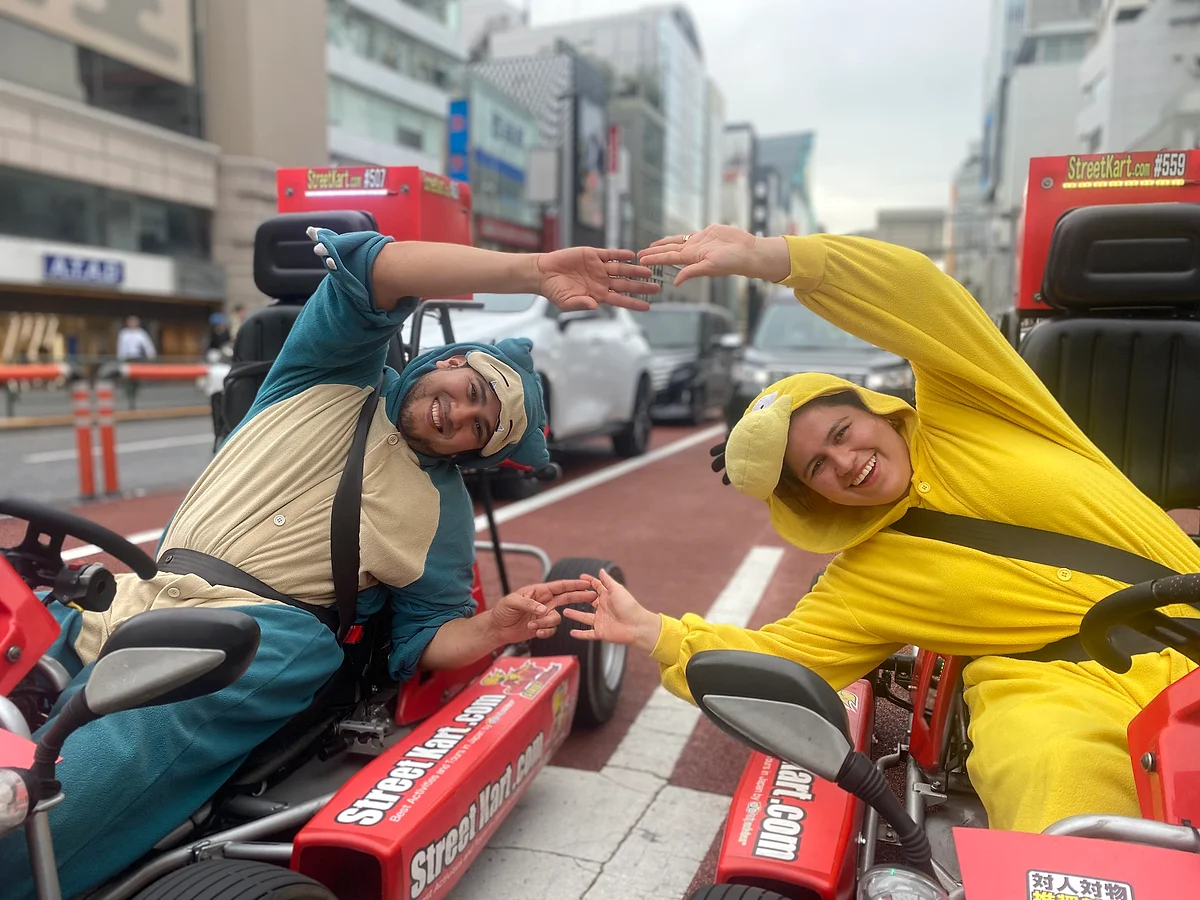
If you're visiting at this time of year, why not take a small detour? On a street kart, you follow a guide through the streets and watch the city as it starts to turn.
But when your group spans different ages and fitness levels, trip planning grows fast. Who can drive? Where will the non-drivers spend their time? When do you need to book by? The questions pile up.
This article focuses on cutting down your prep and maps out how to fit street karting into a trip to Tokyo during autumn-leaf season.
How Much Prep Can You Cut During Autumn-Leaf Season?
Here's the short answer: you can cut quite a lot. But a few things can't be skipped.
A street kart isn't something you drive anywhere you like. Each store has set courses, and you ride as part of a guided tour, with a guide leading the way. You don't need to look up directions in a map app, and you don't need to memorize where to turn. You just follow the kart in front of you. As you ride, the wind hits your face and the sounds of the city come straight to your ears. You'll feel the cool autumn air on your whole body, too.
In Brazil, autumn runs from March to May. Brazil is in the Southern Hemisphere, so its seasons are the opposite of Japan's. For visitors from South America, watching Tokyo's tree-lined streets slowly turn yellow may feel like something new. So you'll want to spend your time enjoying those changing colors.
That's why it helps to sort your prep into "can skip" and "can't skip." Deal with the can't-skip items first. Then you can spend all the time you have left on autumn in Tokyo.
Prep You Can't Skip: License, Booking, and Getting There
First: check your driver's license. This is the one thing you can't skip.
Which licenses let you drive? Do you need an International Driving Permit? What should you bring on the day? These requirements vary by country and license type, so this article doesn't give a definite answer. Before you leave, check the official driver's license page to see whether your license qualifies.
If you're traveling as a group, check for everyone who wants to drive. The worst case is finding out at the store that "you can't ride with this license."
The same goes for age and other participation requirements. If your group includes a range of ages, check the official website first to see who can drive. Don't book for everyone without checking the requirements. Decide who will ride and who won't first, then book. That makes the day itself much simpler.
Second: when to book. Weekends tend to fill up, so we recommend booking early. Once your itinerary is set, book the kart first so you don't have to think about it later. Bookings are accepted via Facebook, LINE, and email. See the official website for detailed steps.
Third: how to get to the store. The stores have no parking, so please use public transportation.
Here's how far each store is from the nearest station. Shibuya store: 5 minutes' walk from Shinsen Station. Akihabara Store 1: 3 minutes' walk from Suehirocho Station. Shinagawa store: 3 minutes' walk from Kita-Shinagawa Station. Tokyo Bay store: 8 minutes' walk from Shin-Kiba Station. Looking at the station and store on a map once beforehand makes the day go more smoothly.
On the day, you need to be at the store 15 minutes early for check-in and the safety briefing. When you visit autumn-leaf spots first, side trips tend to run long. Work backward from the time you need to be at the store and plan the earlier part of your day around it, so you won't be rushed.
Once these three are done, most of the prep is behind you.
A quick note about rain, too. On rainy days, raincoats are provided free of charge. If you have any questions about clothing, check the official website.
Knowing how weather is handled also makes decisions easier on the day. In light to moderate rain, tours go ahead as planned. In heavy rain or typhoons, tours are canceled, and longer courses may be shortened. If a tour is canceled, you can choose from three options: switch to a shorter tour and get the difference refunded, move to another day, or cancel for a full refund. Autumn weather can be changeable, so leaving a spare day in your itinerary gives you room to reschedule. Cancellation is free up to 7 days before.
Let's cover the basics of what to wear as well. The official guidelines recommend closed-toe shoes (sneakers recommended) and clothes that are easy to move in, such as jeans. A jacket suited to the season is also listed. Avoid open-toed shoes, heels, skirts or dresses, and expensive clothing. On a kart, the wind hits you directly. Even if the day is warm, bring a layer you can throw on. Pack your things into a small bag that fits on the kart. The store lockers are for small items and aren't suitable for large luggage like suitcases. If you're riding on a travel day, plan to drop your luggage at the hotel first.
A word about language, too. Guidance on the day is basically in English. Guidance in Japanese or other languages depends on the staff that day and isn't guaranteed. If you'd like a language other than English, contact them through the official website in advance. The website is available in 22 languages.
Which Store to Choose for Viewing Tokyo's Autumn Colors
There are seven stores in Tokyo. However, Akihabara Store 1 and Store 2 are in nearly the same location, and so are the Shibuya store and Shibuya Annex. Seven stores doesn't mean seven separate areas to ride in. Keep that in mind.
Below, based on the places listed in each store's route materials, we'll look at autumn highlights store by store. The actual roads you take may vary by tour, so check the official website for the latest information.
Shibuya Store and Shibuya Annex: To the Zelkova Trees of Omotesando
If you want to enjoy autumn "color," the Shibuya store and Shibuya Annex routes are good choices. Their route materials include Omotesando, a street known for its zelkova trees.
It's the street lined with Omotesando Hills and Tokyu Plaza Omotesando Harajuku. You ride your kart under zelkovas that are starting to change color, and you can hear the leaves rustling. If yellow and brown leaves are reflected in the glass of the buildings, that alone looks like a painting. It's the kind of color combination you never get tired of.
The route materials also include Harajuku's Takeshita Street and the Shibuya Scramble Crossing. Takeshita Street, lined with colorful shops. The Scramble Crossing, where waves of people all start moving at once. And from there, to the calm colors of the tree-lined avenue. It's like switching from a fast beat to a relaxed bossa nova. Music lovers will appreciate the shift.
Meiji Jingu and Yoyogi Park are near the route. Both are 20 minutes' walk from the Shibuya stores. They're good places to remember for a walk after you get off the kart.
Akihabara, Shinagawa, and Tokyo Bay: Autumn Colors in the City and on the Water
The route materials for the Akihabara stores list the Marunouchi building of Tokyo Station, Ginza, and Akihabara Electric Town. In the soft autumn light, the red-brick station building looks even deeper in color. In Ginza, there's the 4-chome intersection with the Wako clock tower. Nearby are Kanda Myojin and Ochanomizu, home to the Holy Resurrection Cathedral (Nikolai-do). Rather than changing leaves, this route is about the colors of the city itself: brick, stone, and neon.
The Shinagawa store's route materials include the Takanawa area, home to Sengakuji Temple, the Shibaura and Tamachi bay area, and views of Tokyo Tower and the Rainbow Bridge in the distance. You get both the calm atmosphere of temples and shrines and the open views of the waterfront. According to the course materials, the Shinagawa store also has an evening option with lighter traffic.
The Tokyo Bay store has a waterfront route featuring the Rainbow Bridge, Odaiba, and Tokyo Tower. Autumn leaves aren't the main attraction on this route. Instead, the highlight is the clear autumn sky, the blue of Tokyo Bay, and the suspension bridge together. The course materials say that evening slots let you enjoy the night views too. At night, the Rainbow Bridge is lit up in seven colors. Days get shorter in autumn, so you can split your day in two: walk around autumn-leaf spots during the day, then take in the waterfront lights in the evening. If someone in your group says, "I've seen enough leaves, let's see the sea next," this store is a good pick.
How Do Companions With Different Fitness Levels Spend the Waiting Time?
When your group varies in age and fitness, not everyone will necessarily ride. Some won't meet the driving requirements. Others may say, "I'm happy just watching today." Check the participation requirements on the official website, then talk it over together and decide who will ride.
One thing to know up front: the karts are single-seaters. No passengers are allowed. So "the younger ones drive and I'll ride along next to them" isn't an option. Whether non-riders can wait at the store is something to ask through the official website beforehand. Also, the karts have no suspension, so you feel every bump in the road. For that reason, participation isn't recommended for people who are pregnant. If you have concerns, consult a doctor.
Here, we'll assume some people won't ride or want to rest a bit, and look at ways to spend time around each store.
At the Shinagawa store, Shinagawa Shrine is 5 minutes' walk away. It's one of the Tokyo Ten Shrines, with a torii gate at the top of a stone staircase and a Fujizuka (a miniature Mount Fuji). The stairs and Fujizuka are hard on the legs, so if you're not confident in your stamina, just looking up at the torii from below still gives you the feel of the place. The Takanawa Prince Hotel, 15 minutes' walk away, has a Japanese garden, along with restaurants and afternoon tea. If you'd rather not walk much, you can wait at the nearby Starbucks Shinagawa Grand Commons (5 minutes' walk). After the karting, head to Tennozu Isle, 20 minutes' walk away. Meeting up with everyone at a canal-side café is fun, too.
At the Akihabara stores, Ueno Park is 5 minutes by train. There you'll find Ueno Zoo, the Tokyo National Museum, and the National Museum of Western Art. You can take it easy while looking at the park's trees. Kanda Myojin is 10 minutes' walk away. It's known as the guardian shrine of all Edo. The energetic ones ride the karts. The ones who want to relax go to the shrine or a museum. Then everyone meets up afterward. You can split up like that.
At the Shibuya stores, Meiji Jingu and Yoyogi Park are both 20 minutes' walk away. You'll be walking through a large forest, so they suit people who like to walk. For those who find long walks hard, there's Shibuya Hikarie, 10 minutes' walk away, and the observation deck at Shibuya Scramble Square. Looking down on Shibuya from up high and searching for your companions, thinking "Are they riding around over there?", is a lot of fun.
The Tokyo Bay store in Shin-Kiba is a bit far from nearby sights. Odaiba and Toyosu Market are 10 minutes by car. Rather than splitting up here, it may be easier to have everyone head to Odaiba together after the karting.
At every store, there's a convenience store within 5 minutes' walk, and there are restrooms inside the store. Those waiting can easily find a place right by the store to buy more drinks or take a breather before the start. Decide on a meeting place and time before the riders head out.
The key is not to let the waiting time become "leftover time." Let the non-riders enjoy autumn in Tokyo in their own way, too. If you can do that, you're closer to a day where everyone feels "I'm glad I came." When going out in a big group, everyone does their own thing and then meets up at the end. That's a familiar way of spending the day in Brazil, and it works just as well in Tokyo!
Street Kart's Track Record
As of November 2023, across all stores, Street Kart had run more than 150,000 tours, served over 1.34 million customers, and received more than 20,000 reviews, with an average rating of 4.9 out of 5.
What to Check on the Official Website Before Booking
If you want to fit street karting into your trip to Tokyo during autumn-leaf season, there isn't much to do.
Check the license and participation requirements on the official website for everyone who wants to drive. Weekends fill up quickly, so book your slot early. Take public transportation to the store. If some people won't ride, check on the official website before booking whether they can wait at the store and how long the tour takes, and decide on a meeting place and time.
Once that's done, all that's left is to enjoy the city in its autumn colors.
Prices vary by season and time of day, so check the official website for the latest prices. Also check the official website for details on how to book, what to wear, and weather policies.
Before the zelkova leaves have all fallen, why not feel the wind as you take in autumn in Tokyo? Riders and those waiting nearby, each at their own pace. The plan is simpler than you might think.
Once your itinerary is set, start by checking the requirements and booking options on the official website. That's all it takes to set your autumn day in motion.
This article was originally written in Japanese and translated using AI. Some expressions may read unnaturally, and we appreciate your understanding. For the most accurate and up-to-date information, please refer to the official site at kart.st.
Street Kart is not affiliated with Nintendo or the Mario Kart series in any way. We do not provide costumes of Nintendo characters, and such costumes may not be worn during tours even if brought by participants.