
How Do You Enjoy Tokyo with Travel Companions of Different Stamina Levels? 4 Street Kart Areas Chosen by How the Scenery Changes
How Do You Enjoy Tokyo with Travel Companions of Different Stamina Levels? 4 Street Kart Areas Chosen by How the Scenery Changes
"Those stairs might be a bit much for me." "I can keep walking all day!"
On the same trip, you'll sometimes hear both of these at once. When you tour Tokyo with a group whose ages and energy levels vary widely, the conversation often stalls on "How much are we walking today?" before you even get to where you're going. Whether you're in Brazil or Japan, group travel comes with pretty much the same headaches.
Take a three-generation family trip. Grandpa is already a little worn out just from changing trains at the station, while the teenage grandkid wants to see both Harajuku and Ginza. Put everyone's wish list on a map as-is, and the whole day goes to getting from place to place.
In Tokyo, though, there's a way to take in one city scene after another without walking more: a street kart tour. This article goes area by area through which Tokyo locations to choose and what scenery you'll see from each. Requirements to join vary from person to person, so at the end we've also covered how to check them.
Sightseeing on Foot vs. Sightseeing Where the Scenery Comes to You
When you sightsee on foot, the pace is usually set by the most energetic person in the group. The people at the back end up watching their feet instead of the view. Each time they ask "Where to next?", they look a little apologetic. It's a familiar sight on any trip, isn't it?
With a kart, it's the other way around.
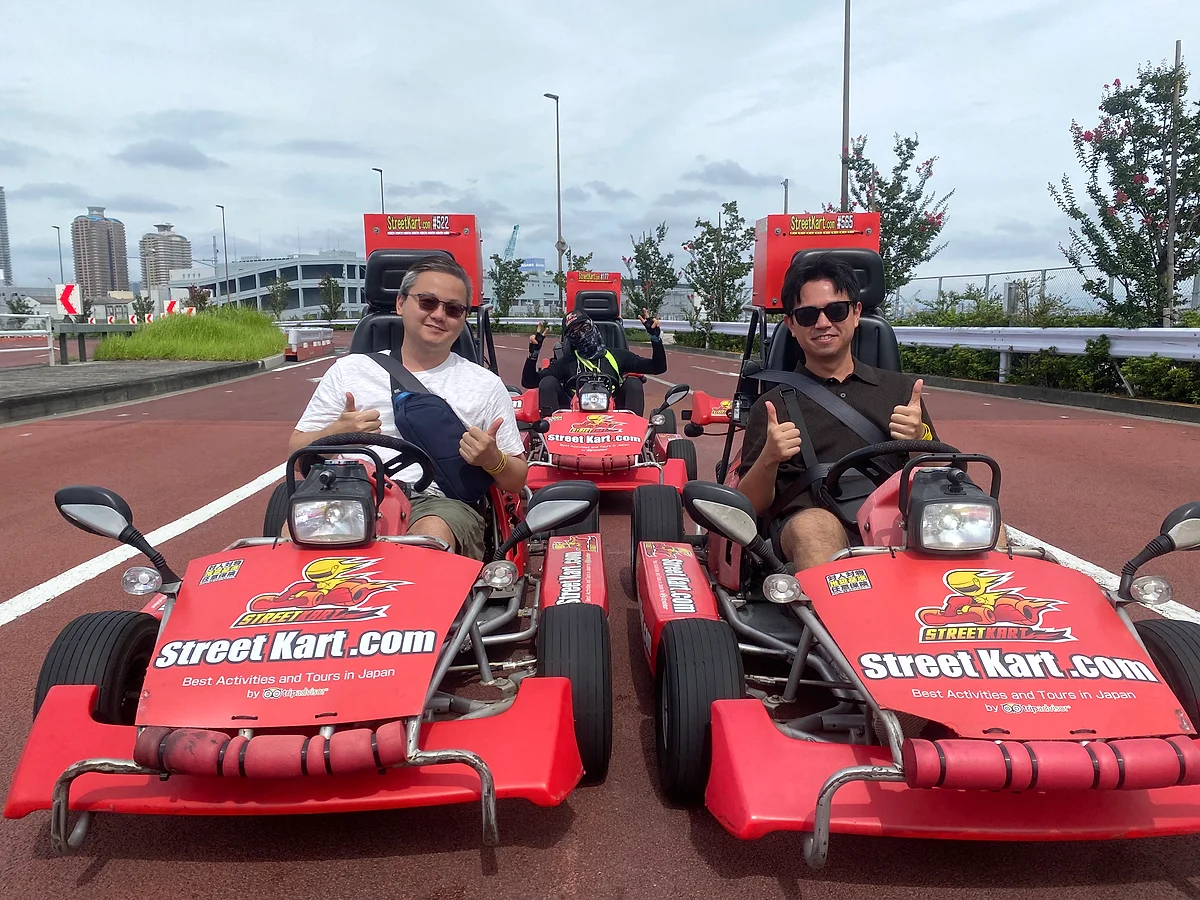
You sit down and take the wheel. That's it, and the city starts rushing toward you. From a low, open-top seat, building walls look much taller. You hear the signals chiming at intersections. You feel the tires gripping the road. Along the waterfront, the breeze carries a hint of salt. The city feels completely different from how it does on foot.
To a DJ's ear, a good set moves from track to track without stopping the dance floor. Sometimes the BPM comes down little by little, sometimes the whole mood flips at once. Tour routes work a bit like that too: the city's colors and sounds change from one stretch to the next.
One important point first. Street Kart runs guided tours led by a guide, and each location has a set course. For details on whether you can make detours or drop out partway through, please check the official website (kart.st).
For a group with mixed stamina, this actually makes things easier. Nobody has to decide "Where should we go next?" on the spot. That's one less moment spent watching faces to see if someone is pushing themselves too hard.
Before you set off, there's a safety briefing. You'll learn how to operate the kart, the day's route, and what to watch out for while driving, and then you head out onto public roads. Goggles are lent free of charge. Once you're moving, you follow the guide in front of you and drive according to Japanese traffic rules. There's also a system in place for the guide and participants to stay in contact. The tour includes stops at photo spots along the way.
How the Scenery Changes Across 4 Areas
There are seven locations in Tokyo. However, Akihabara and Shibuya each have two locations in nearly the same spot, so they aren't spread across seven separate areas.
Below, we follow how the scenery shifts, based on the places listed as highlights for each location's route. To be safe, check the details of the route for your day on the official website before booking.
Akihabara: From the Colorful Signs of Electric Town to a Red-Brick Station, Then on to Ginza
You start in Akihabara Electric Town. Huge signs crowd the area around Yodobashi Camera and Akihabara UDX. There's color everywhere. To a graphic designer, it's a bold palette that looks like primary colors stacked straight on top of each other.
From there you head to the Marunouchi Building of Tokyo Station, and the colors calm down all at once. The red-brick station building opened in 1914 and finished its restoration work in 2012. Seen right after all that neon, it feels far more substantial.
Its architectural style is known as "Tatsuno-style free classic." If you want photos, the front of the building on the Marunouchi side is a well-known photo spot.
Once you enter Ginza, you pass the Wako clock tower, the Kabuki-za theater, and a row of stone and glass buildings. The colors turn to understated grays and golds.
Ginza Chuo-dori and the 4-chome intersection have been the center of a busy shopping district since the Meiji era. Department stores like Ginza Mitsukoshi and Matsuya Ginza line the street. Here, the colors of Electric Town's signs give way to the glow of shop windows, and you can follow that change without ever leaving your seat.
If your group has older members who love historic buildings and younger members who love pop culture, this area works for both. Over the course of one tour, each person gets their own "This is what I wanted to see!" moment in turn. That's what makes it great.
Shibuya: From the Crowds at the Crossing to Harajuku's Pop Colors and Omotesando's Zelkova Trees
Shibuya is the area where the changes in tempo are easiest to feel.
Shibuya Scramble Crossing. With Hachiko Square and SHIBUYA109 right in front of you, the moment the light changes, waves of people start moving from every direction. In beat terms, you jump straight into peak time.
In Harajuku, around Takeshita Street and Laforet Harajuku, the colors get much brighter. The whole neighborhood shifts into a slightly bouncy rhythm. The rebuilt Harajuku Station building is another highlight here.
By the time you reach Omotesando, a line of green zelkova trees runs straight ahead. The street with the low-rise Omotesando Hills has the calm of a groove with the tempo dialed down. Distinctive buildings designed by architects, including Tokyu Plaza Omotesando Harajuku, line the street, and comparing their shapes one by one is part of the fun.
From the Shibuya locations, Takeshita Street and Omotesando are each said to be about a 15-minute walk away. The tour passes through both. Even group members who find walking hard can see how all three neighborhoods differ on the same day.
Shinagawa & Tokyo Bay: From Between the Skyscrapers to the Waterfront, as the Sky Opens Up
The Shinagawa route covers the high-rise area around the station, including Shinagawa Intercity, and the Shibaura and Tamachi waterfront is another highlight. The Rainbow Bridge seen from the Shinagawa side and Tokyo Tower in the distance are also highlights of this route. It also includes the Takanawa area, home to Sengakuji Temple, where an office district sits right next to old temples and shrines, a very Tokyo kind of mix. Shinagawa Prince Hotel and Takanawa Gateway Station are also listed as highlights around the station.
At the Tokyo Bay location (Shinkiba), you can enjoy the warehouse district of the Shinkiba area and the waterfront views. Odaiba, home to the Fuji Television headquarters building, the 798-meter Rainbow Bridge spanning Tokyo Bay, and the 333-meter Tokyo Tower completed in 1958 are also highlights of this route. The Rainbow Bridge is also known for lighting up in seven colors at night.
The Tokyo Bay location's course is described as a route where you can enjoy the night views if you drive in the evening. Check the official website to see which time slots are available.
The moment you come out from between the buildings onto the waterfront, the sky suddenly opens up. If you grew up in a Brazilian seaside city, this feeling will probably bring back a bit of home.
Plan Before and After the Tour Around "How Much Walking"
How you spend the time before and after the tour makes a real difference in how tired you'll be by the end of the day.
First, getting there. The locations have no parking, so take public transportation.
Here's how far each location is from the station:
- Shinagawa location: 3-minute walk from Kita-Shinagawa Station (10 minutes from Shinagawa Station)
- Shibuya locations: 5-minute walk from Shinsen Station (10 minutes from Shibuya Station)
- Tokyo Bay location: 8-minute walk from Shinkiba Station
If someone in your group has trouble walking, it's a good idea to use the closer station.
On the day, there's check-in and a safety briefing before departure. Allow extra time for that on top of the walk from the station. If you end up jogging because you're running late, you'll be worn out before the tour even starts.
It also helps to decide what to wear the night before. Closed-toe shoes are recommended, sneakers if possible. Avoid open-toe shoes like sandals, heels, and skirts or dresses. In summer, a hat, sunglasses, and sunscreen come in handy.
Pack as light as you can. The locations have lockers for small items, but large luggage like suitcases won't fit. If you book the tour on the day you check out of your hotel, you'll need to arrange to store your big bags somewhere first.
When choosing where to stop by, you'll want to match everyone's stamina.
Shinagawa Shrine, a 5-minute walk from the Shinagawa location, has a torii gate at the top of stone steps and a Fujizuka (a miniature Mt. Fuji mound). Those who want to climb can go up while the others wait below, so it's an easy place for the group to split up. Tennozu Isle, a 20-minute walk away, is a canal-side area where you can drop into a café for a break.
From Akihabara, Kanda Myojin Shrine is a 10-minute walk, and Ueno Park is 5 minutes by train. Being able to cut down on walking by taking the train is a big help. Tokyo Station is about 20 minutes on foot or 5 minutes by train. You could also pair the tour with a later visit inside the Tokyo Station Gallery, after seeing the red-brick building from the outside during the tour.
From the Shibuya locations, Meiji Jingu Shrine is a 20-minute walk, and the forest on the shrine grounds is large, so you'll end up walking quite a lot. On days when someone is tired, you might swap it for an indoor spot like Shibuya Hikarie, a 10-minute walk away. Shibuya Scramble Square, also a 10-minute walk, has the Shibuya Sky observation deck, where you can look down on the crossing you just drove across in your kart.
Near the Tokyo Bay location, CASICA, a café and restaurant at Shinkiba Station, is one option for sitting down and resting before or after the tour.
If some group members don't meet the requirements, or have decided not to drive that day, it's also an option for them to do their own thing just for that time. In Shinagawa, you could meet up at the Starbucks Shinagawa Grand Commons store, a 5-minute walk away. The tour ends when you return to the location and hand back your kart, so choosing a meeting spot near the location makes it easier to regroup. Hearing the drivers talk about what they just saw when they get back is one of the small joys of the trip.
What to Check Together Before Booking
First, the requirements to join. Age and driver's license requirements need to be checked for each person in your group. The karts are single-seaters, and everyone who rides drives their own kart. You can't ride as a passenger next to someone else.
For details on driver's license requirements, please see the driver's license page on the official website. If anyone in your group has health concerns, contacting them before you book will save you from scrambling on the day.
Don't be shy about checking physical considerations, either. The karts have no suspension, so every bump in the road goes straight through to your body. The tour isn't recommended for pregnant people, who are advised to consult a doctor. There are no weight or height limits. However, because the engines are small, larger drivers may find their kart goes a bit slower.
You'll also want to keep an eye on the weather. In light to moderate rain, tours run as planned, and raincoats are lent free of charge. Tours are canceled in heavy rain or typhoons, and longer courses may be shortened. If that happens, you can choose from three options: a shortened tour (with the price difference refunded), rescheduling to another day, or canceling for a full refund. If someone in your group doesn't do well in rain, keeping a backup day in the latter half of your trip makes it easier to reshuffle plans.
Check the language of the guidance on the day, too. Tour-day guidance is basically in English. Guidance in Japanese or other languages depends on the staff working that day and isn't guaranteed. If you're worried about language, reach out through the official website ahead of time.
Next, the schedule. Weekends tend to fill up quickly, so booking early is recommended. Reservations are accepted via Facebook, LINE, and email, and the contact details for each are listed on the official website.
Some people will cheer at the red-brick station, and others will gaze in silence the moment the sky opens up over the bay. Stamina may vary, but everyone can watch the scenery change together.
So, which views will you go see first? Take a look at the routes and requirements for the four areas on the Street Kart official website, and decide together as a group.
This article was originally written in Japanese and translated using AI. Some expressions may read unnaturally, and we appreciate your understanding. For the most accurate and up-to-date information, please refer to the official site at kart.st.
Street Kart is not affiliated with Nintendo or the Mario Kart series in any way. We do not provide costumes of Nintendo characters, and such costumes may not be worn during tours even if brought by participants.